
Selling Your San Diego Business in 2026: The Comprehensive Year-End Exit Strategy

As the sun sets on another year in America’s Finest City, many San Diego business owners find themselves at a crossroads. Whether you are overlooking the tech hubs of University City or managing a boutique in La Jolla, the end of the year brings more than just holiday tourism—it brings a critical window for reflection. If you have been feeling the weight of burnout or are eyeing a well-deserved retirement in North County, selling your business in San Diego requires more than just a "For Sale" sign; it requires a calculated, year-end exit strategy.
Navigating the San Diego market is a unique experience. We aren't just dealing with standard economic variables; we are operating within a high-cost, high-reward ecosystem fueled by biotech, defense, and a resilient tourism sector. Moving from an emotional "I’m done" to a logical "closed deal" involves bridging the gap between what you feel your legacy is worth and what a sophisticated buyer is willing to pay.
At First Choice Business Brokers (FCBB), San Diego University City, we specialize in transforming that transition into a structured, profitable exit.
The Strategic Importance of the Q4/Q1 Pivot
The transition from December to January is the most active period for business acquisitions. Buyers often spend their year-end reviewing capital and looking for fresh investment opportunities to kick off the new year. By preparing your exit strategy now, you position your business to be the "premier listing" when buyer intent is at its peak.
Capitalizing on "New Year" Buyer Psychology
Aspiring entrepreneurs often use the New Year as the catalyst for life changes. In San Diego, we see a surge of interest from individuals relocating from the Bay Area or Los Angeles seeking a "lifestyle business" or a stable service-based company. If your financials are organized and your narrative is clear by December 31st, you capture this wave of motivated talent.
San Diego’s 2026 Economic Pulse
The San Diego economy remains a powerhouse, particularly in the "Golden Triangle." With continued investment in life sciences and the expansion of tech campuses near UTC, the local multiplier effect means service businesses—from commercial cleaning to specialized staffing—are in high demand. A year-end strategy allows you to bake these local growth trends into your valuation.
Financial Housekeeping and the Market Price Analysis (MPA)
Before a buyer ever sets foot in your facility, they will scrutinize your books. Due diligence is a non-negotiable step that begins with your own internal audit.
Moving Beyond the P&L
Many owners rely solely on their Profit and Loss statements, but a sophisticated buyer looks at Seller’s Discretionary Earnings (SDE). This involves "adding back" one-time expenses, your salary, and non-essential perks to show the true earning power of the business.
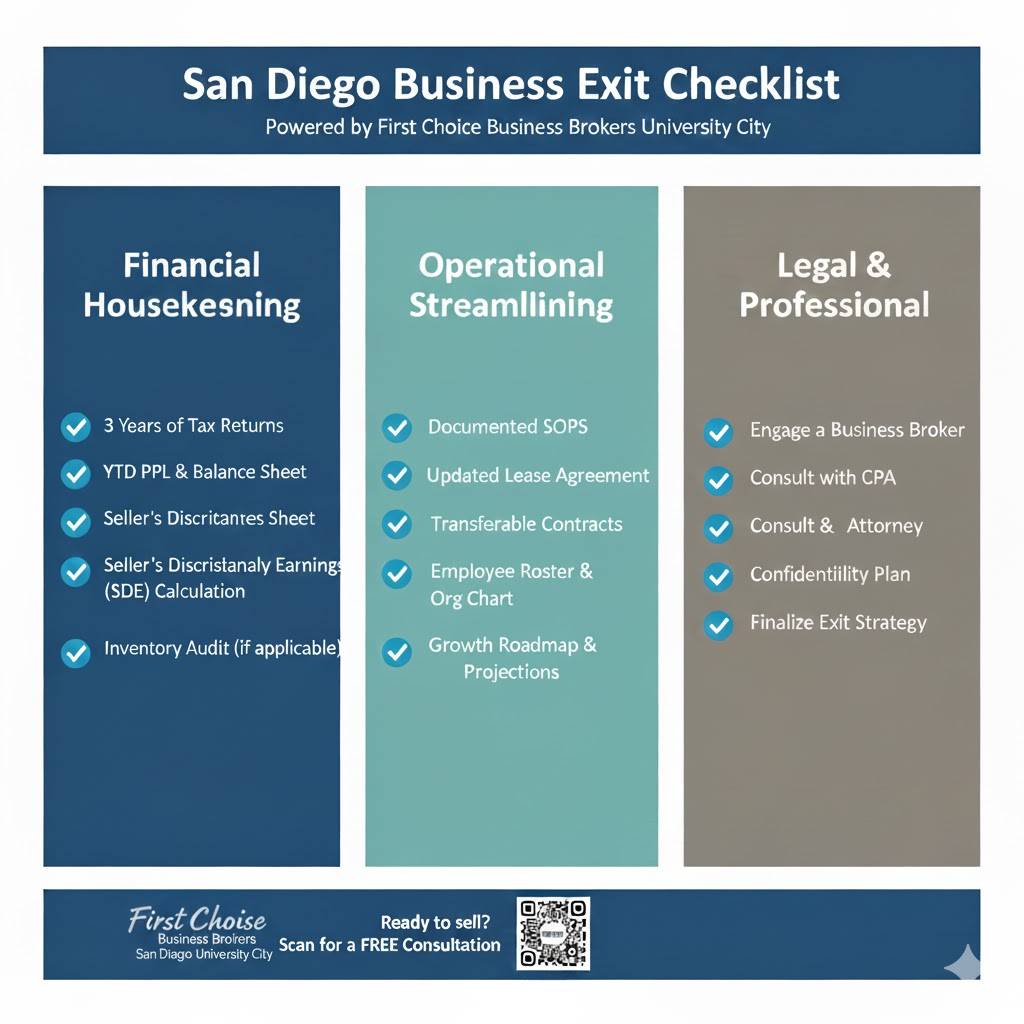
- Scrutinizing Financials: Ensure your 2023, 2024, and 2025 tax returns are consistent.
- Inventory Management: If you are in retail or manufacturing (common in the Miramar area), perform a physical count to ensure your balance sheet reflects reality.
MPA vs. Emotional Valuation
It is natural to value your business based on the years of "sweat equity" you’ve poured into it. However, a Market Price Analysis (MPA) is the only way to arrive at a realistic figure. We analyze comparable sales within San Diego County to ensure you aren't leaving money on the table or scaring away buyers with an inflated "legacy price."
Streamlining Operations for a "Turnkey" Appeal
A buyer is not just purchasing your equipment; they are purchasing your time. If the business cannot function without you for 48 hours, it is a "job," not an "investment." To command a premium price in the San Diego market, you must prove scalability.
Documenting the "San Diego Way"
San Diego has specific regulatory landscapes, from California labor laws to local environmental permits.
- Standard Operating Procedures (SOPs): Create a digital handbook for every role.
- Lease Agreements: In high-demand areas like University City, your lease is one of your most valuable assets. Ensure your "Assignment of Lease" clauses are favorable for a transfer.
Identifying Growth Potential
Buyers pay for the future, not just the past. Highlighting "Sustainable income and growth potential" is key. Are there untapped neighborhoods like Mira Mesa? Could the business expand into e-commerce? Providing a "Growth Roadmap" as part of your sales package adds immense perceived value.
Navigating the Maze of Business Acquisitions
The actual process of selling is a marathon, not a sprint. Understanding the timeline helps manage the "burnout" that many sellers feel during the negotiation phase.
The Confidentiality Factor
In a tight-knit community like San Diego, confidentiality is paramount. You don’t want your employees, competitors, or landlords knowing the business is for sale until the right moment. This is where a broker acts as a shield, vetting buyers before any proprietary information is shared.
The Role of Professional Intermediaries
Navigating the maze of business acquisitions requires a team. While FCBB handles the marketing, valuation, and negotiation, you must also engage with:
- CPA: To understand the tax implications of an asset vs. stock sale.
- Attorney: To review the final Purchase and Sale Agreement (PSA).
Checklist: Documents You Need to Start Your Exit
- [ ] Past 3 years of Federal Tax Returns.
- [ ] Year-to-Date (YTD) P&L and Balance Sheet.
- [ ] Current Lease Agreement and any amendments.
- [ ] Equipment list with estimated values.
- [ ] Employee roster (names, roles, and pay rates).
Conclusion: Achieving Peace of Mind
Selling a business is likely the largest financial transaction of your life. By shifting from an emotional perspective to a logical, data-driven strategy, you ensure that your legacy is preserved and your financial future is secure. Whether you’re looking to enjoy the beaches of Del Mar or start a new venture, a proper year-end exit strategy provides the "peace of mind" that comes from knowing you didn't leave your exit to chance.
Frequently Asked Questions
How long does it typically take to sell a business in San Diego?
While every industry varies, the average timeline is 6 to 9 months. Starting your preparation in December aligns you perfectly for a mid-year closing.
Do I need a Market Price Analysis if I already have an offer?
Yes. Without an MPA, you have no benchmark to know if that offer is fair. Many "off-market" offers are lower than what the open market would yield.
What is the most common reason deals fall through?
Incomplete due diligence. If a buyer finds discrepancies in your financials or lease terms mid-way through the process, trust is broken, and the deal often collapses.
Should I tell my employees I am selling?
Generally, no. Confidentiality is essential for maintaining staff morale and business stability. We recommend informing key staff only after a solid offer is on the table and all contingencies have been cleared.
Ready to take the next step in your San Diego business journey?
Contact First Choice Business Brokers, San Diego University City, for a confidential consultation or a professional Market Price Analysis. Whether you are exploring Business for Sale San Diego listings or preparing your own exit, we are your local partners in success.
Disclaimer: The information provided in this guide is for general informational purposes only and does not constitute legal, financial, or professional advice. Prospective buyers/sellers should conduct their own research and consult with qualified professionals, such as CPAs or Attorneys, before making significant financial decisions.
Recent articles for you